
CBD Oil News
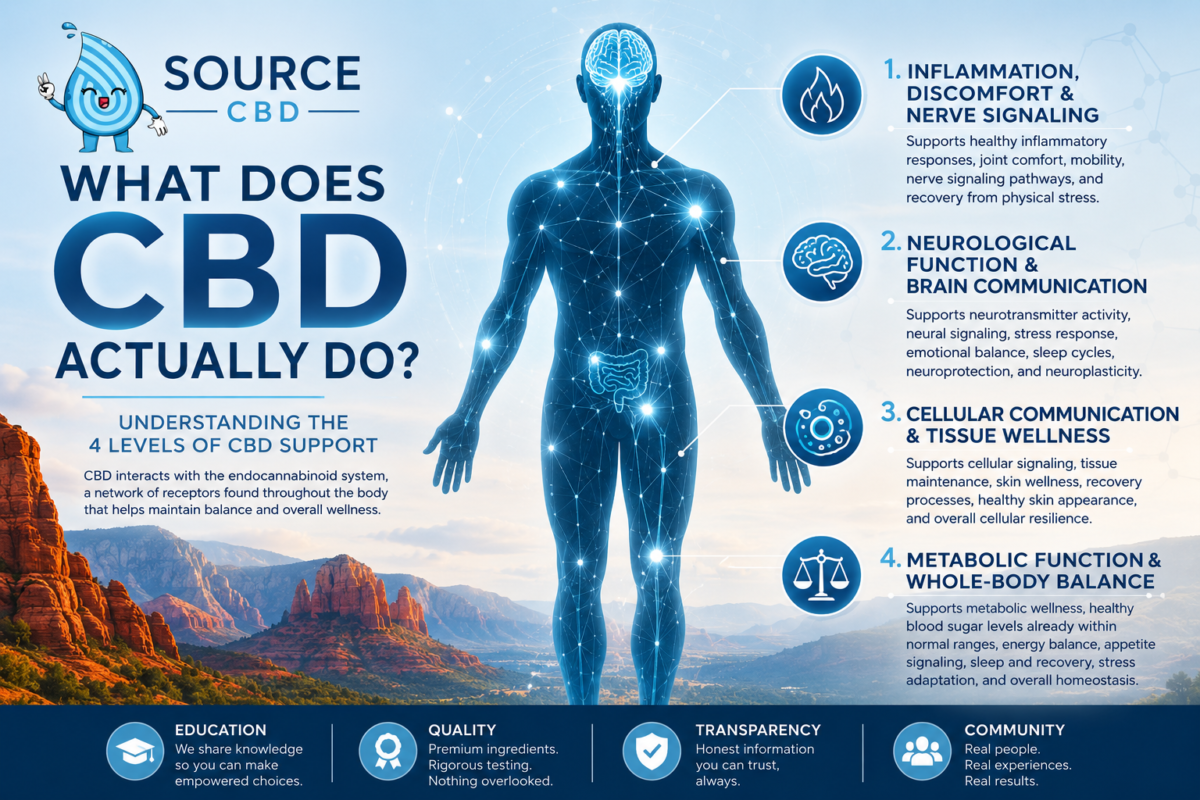
What Does CBD Actually Do? Understanding the 4 Levels of CBD Support
Jun
This morning, Ian and I were on the phone with one of our sales representatives discussing CBD and the many ways people use it as part of their wellness routine.
As the conversation evolved, Ian started diving into the science behind the endocannabinoid system, inflammation, neurological function, cellular communication, and overall wellness.
About halfway through, I found myself thinking, I forget how much knowledge is in this man’s head.
Over the years, Ian has educated physicians, pharmacists, compound pharmacists, veterinarians, healthcare practitioners, and thousands of customers. He’s spent decades studying cannabis, hemp, cannabinoids, and the endocannabinoid system long before most people had ever heard of CBD.
After more than a decade in this industry, conversations like this remind me why Source CBD is still here while so many companies have come and gone.
We’ve never focused on hype.
We’ve focused on education.
We’ve focused on quality.
And we’ve focused on helping people better understand how the endocannabinoid system works within the body.
One thing Ian pointed out during our conversation is that many people think CBD only supports one thing.
Some people associate it with relaxation.
Others think of it for sleep.
Some think of it for recovery after exercise.
The reality is that CBD interacts with the body’s endocannabinoid system, a network of receptors found throughout the brain, nervous system, immune system, skin, and many other tissues.
The endocannabinoid system’s primary role is to help maintain balance throughout the body.
When we started talking through it, we realized that CBD support can generally be viewed through four different levels.
One thing I found especially interesting during our conversation was how often people underestimate the reach of the endocannabinoid system.
Most people think about CBD in terms of a symptom.
Stress.
Sleep.
Recovery.
Discomfort.
But the endocannabinoid system isn’t organized around symptoms. It’s organized around balance.
When Ian started explaining it, he wasn’t talking about individual conditions. He was talking about systems.
Inflammation.
Neurological communication.
Cellular signaling.
Metabolic function.
These are some of the same areas researchers continue to explore when studying the endocannabinoid system and its role in maintaining homeostasis throughout the body.
After years of customer feedback and decades of scientific research, one thing has become clear: the endocannabinoid system reaches far beyond what most people realize.
That’s why we started looking at CBD support through four different levels.
Level 1: Inflammation, Discomfort & Nerve Signaling
This is where many people first become interested in CBD.
Researchers have identified endocannabinoid receptors throughout the immune system, nervous system, joints, muscles, and connective tissues. Because of this, scientists continue to study the role cannabinoids may play in supporting healthy inflammatory responses and normal pain-signaling pathways.
Areas of ongoing interest include:
- Healthy inflammatory responses
- Joint comfort and mobility
- Recovery from physical stress
- Nerve signaling pathways
- Overall comfort and movement
One thing we’ve consistently heard from customers over the years is that when inflammation is better supported, many other areas of wellness often seem to improve as well.
Level 2: Neurological Function, Neuroprotection & Brain Communication
The endocannabinoid system is deeply involved in communication throughout the brain and nervous system.
Scientists continue to explore how cannabinoids influence neurotransmitter activity, neural signaling, neuroprotection, and the body’s ability to maintain balance during periods of physical and emotional stress.
Current areas of research include:
- Neurotransmitter activity
- Nervous system signaling
- Neuroplasticity
- Stress responses
- Emotional regulation
- Sleep cycles
- Brain-body communication
Researchers continue to investigate the relationship between the endocannabinoid system and the brain’s ability to adapt, reorganize, and maintain healthy communication pathways throughout life.
Level 3: Cellular Communication, Recovery & Tissue Wellness
One of the most fascinating aspects of the endocannabinoid system is that it exists throughout the body, including within the skin.
Every day, your body is repairing, replacing, and maintaining billions of cells. Scientists continue to study how cannabinoids influence cellular communication, tissue maintenance, inflammatory signaling, and the body’s natural recovery processes.
Areas of ongoing research include:
- Cellular signaling
- Tissue maintenance
- Skin wellness
- Recovery processes
- Healthy skin appearance
- Scar remodeling research
- Cellular resilience
This growing area of research has helped fuel interest in cannabinoids for both topical wellness products and broader conversations about cellular health.
Level 4: Metabolic Function & Whole-Body Balance
The endocannabinoid system doesn’t operate in isolation.
It helps coordinate communication between many of the body’s major systems.
Scientists continue to explore the relationship between the endocannabinoid system and:
- Metabolic wellness
- Blood sugar regulation already within normal ranges
- Energy balance
- Appetite signaling
- Sleep and recovery
- Stress adaptation
- Overall homeostasis
Homeostasis is simply the body’s ability to maintain balance. When one system becomes overwhelmed, other systems often feel the effects as well.
This is one reason the endocannabinoid system has become such an important area of scientific research. It isn’t focused on a single organ or a single symptom. It acts as a communication network that helps the body maintain balance across multiple systems at once.
Looking Beyond Symptoms
What makes CBD so unique is that it doesn’t work like many conventional approaches that focus on a single target.
Instead, CBD interacts with a system whose primary purpose is balance.
That’s why researchers continue to study the endocannabinoid system’s relationship with inflammation, neurological function, cellular communication, metabolism, and overall wellness.
The more we learn about the endocannabinoid system, the more we realize just how interconnected the body truly is.
And after all these years, that’s still one of the things that fascinates Ian the most.
FDA Disclaimer
These statements have not been evaluated by the Food and Drug Administration. Source CBD products are not intended to diagnose, treat, cure, or prevent any disease. Always consult with your healthcare professional before starting any dietary supplement, especially if you have a medical condition, are pregnant or nursing, or are taking medications.
This article is intended for educational purposes only and should not be considered medical advice.
